Blog

  /  

Cost Comparison: Electric Inserts vs Traditional Fireplaces

Cost Comparison: Electric Inserts vs Traditional Fireplaces

Most fireplace cost guides stop where the real story begins. They quote a showroom tag, maybe a rough install number, and call it a comparison. Then the homeowner signs, the installer leaves, and the next decade quietly costs more than the fireplace itself. Annual chimney sweeps. Gas service calls. Heat vanishing up a flue while the thermostat keeps working. None of it shows up on the receipt that closed the deal.

EcoSmart Fire's engineering team and the architects who specify our ranges have been working through this calculation for over twenty years, across more than 250,000 installations in 75 countries. Here is what a complete picture actually looks like.

A fair comparison of electric fireplace inserts vs traditional fireplaces has to stretch the timeline. Ten years is the right window, because that is roughly how long a primary fireplace lives before the conversation about replacement or refurbishment starts. Across that decade, four cost categories decide which technology actually wins: the upfront price of the unit, the installation and infrastructure cost, the running cost in both heat and ambience modes, and the maintenance and servicing tail. Inside those four categories sit four contenders: electric inserts, gas fireplaces, traditional wood-burning fireplaces, and the option most cost guides overlook entirely, bioethanol. The picture changes once all four are on the same page.

Published:
· Updated:

Upfront cost: what you pay before installation even starts

Loading image...
thumbnail: webimage-Motion-60SS-Electric-FireplaceMotion 60SS - Residential Space CGI

Across the four technologies, upfront unit cost runs from entry-level (electric portables) at the bottom to premium-tier wood-burning at the top, with gas and bioethanol sitting between them in the mid-to-premium band. That spread is wider than most buyers expect, and the drivers are not what showroom signage usually highlights.

Wood-burning units carry the heaviest unit cost not because the appliance itself is expensive in isolation, but because the unit and its required structure travel together. A zero-clearance wood firebox is itself only a portion of the install, with Class A chimney, masonry, and hearth materials sitting alongside it. The unit price you see quoted often understates what you are actually buying. Gas inserts sit a tier lower, with a typical fireplace insert package quoted in the mid range. Electric inserts span the widest band of any single category, from entry-level portable models to premium architectural inserts with linear glass and high-fidelity flame technology.

Bioethanol is the category most buyers have never priced. The premium tier sits at the architectural end with multi-burner, recessed installations, but the entry point for a freestanding or insert-style bioethanol fire is closer to the mid-range gas band, with no infrastructure attached. EcoSmart Fire introduced the architectural bioethanol fireplace category and remains the benchmark against which other formats are measured, which is why the Flex and Frame ranges are specified for commercial and high-end residential installations worldwide. That difference matters more in the next section than this one.

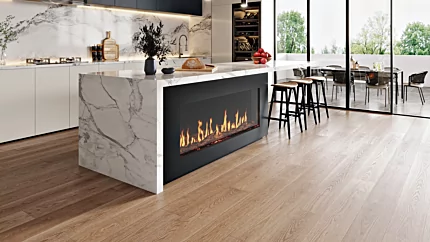
EcoSmart Fire's electric range fits this story cleanly. The Switch series, an architectural electric range with six sizes spanning 44 in to 120 in (available in the US and Canada), sits in the premium tier on unit cost, justified by the linear footprint and the flame realism that defines the category. The Motion series, also six sizes from 30 in to 120 in (US and Canada), occupies the same premium architectural band with its proprietary Motion Picture Technology flame display. On the bioethanol side, our Flex and Frame ranges sit in the same architectural specification conversation, with heat output reaching the high end of the bioethanol range for fully open-flame installations. For specifiers, the value is not the unit price itself but what the tier buys: a fire that reads as a permanent piece of the room's architecture, not a portable appliance.

One context note before the table. Specific dollar figures in this category are notoriously regional. The same fireplace insert costs differently in Sydney, London, Los Angeles, and Berlin. The tiers below hold; the precise numbers shift with each market.

Technology

Tier position

Heat range

Key cost driver

Electric inserts

Entry-level to premium

5,000 to 10,000 BTU/hr (1.5 to 3 kW)

Display technology, glass scale, linear length

Gas inserts

Mid to premium

20,000 to 40,000+ BTU/hr (5.9 to 11.7+ kW)

Burner specification, log set, glass enclosure

Wood-burning

Premium

30,000 to 80,000+ BTU/hr (8.8 to 23.4+ kW)

Firebox material, masonry, chimney system

Bioethanol

Mid to luxury

Up to 13 kW (44,350 BTU/hr)

Burner length, glass, architectural finish

The takeaway from the upfront column is narrower than it looks. Yes, electric inserts can start at the lowest entry point of the four. But buyers shopping at the architectural end of the market will find electric, gas, and bioethanol clustered closer than they expect. The real separation happens at install.

Installation cost: where traditional fireplaces quietly become expensive

Electric inserts and bioethanol fireplaces eliminate the two largest installation expenses a fireplace project carries: the chimney or flue, and the gas line. Take those out and the install column becomes a question of trades and a few hours of work, not weeks of coordination.

Wood-burning installation is the heaviest of the four. A zero-clearance wood fireplace install, including the unit, Class A venting, structural work, hearth, and labour, sits at the high end of any fireplace project budget, with masonry chimney restorations adding significantly more when an existing structure needs rebuilding to safely carry combustion, according to Fireplace Experts' 2026 cost analysis. The U.S. Department of Energy's Energy Saver resource on wood and pellet heating puts it bluntly: it is not uncommon to pay as much for the chimney as for the appliance.

Gas fireplaces sit a long way below wood, but the install bill is still meaningful. A gas insert install sits meaningfully below wood on the installation column but still represents a significant project cost, with the National Association of Realtors' 2025 home maintenance guide noting that running a gas line from the meter adds another notable line item on top.

Electric inserts skip almost all of this. A Switch or Motion install needs a dedicated 110 to 120 V or 220 to 240 V 20 Amp circuit and an electrician to wire it. There is no flue penetration, no roof work, no gas line, no chimney.

Bioethanol goes one step further on the install column. Our fireplace inserts range sits in the same vent-free, zero-clearance category as electric, with the further simplification of no electrical work at all in most freestanding bioethanol configurations.

What the four technologies need on site is the clearest way to see the gap. Wood-burning needs a mason, a structural engineer, a roofer, and a sweep certification before first use. Gas needs a certified gas fitter and an electrician for ignition controls, plus a building inspection. Electric needs an electrician for the dedicated circuit. Bioethanol, in most configurations, needs only the buyer's own carpenter for the recess.

There is a side story worth a sentence here. A surprising number of high-end residential projects only realise the cost of a chimney near the end of the design phase, when the structural engineer prices the load path and the architect re-prices the roof penetration. Electric and bioethanol inserts get specified at the design stage precisely because they remove that surprise from the schedule.

Running costs: the number that shapes the next ten years

Once the install bill is behind you, the next decade of cost comes down to one number: how much does the fire actually cost to run? Run an electric insert in flame-only mode and it costs roughly two cents per hour at the current U.S. average residential electricity rate. Run the same insert in flame plus heat at 1,500 W and it costs roughly 24 to 27 cents per hour.

The flame-only number comes from how little electricity an LED flame display actually consumes. The Switch range draws between 42 and 106 watts when running flame-only; the Motion range draws between 30 and 85 watts. At the Energy Information Administration's November 2025 national average of 17.78 cents per kilowatt-hour, reported by Palmetto, 50 watts of draw works out to roughly 0.9 cents per hour. Even at the top of the Switch range, flame-only ambience is well under two cents an hour.

That is the ambient case closed. The heating case is different.

Switching the heater on changes the calculus, but not as much as buyers fear. A 1,500 W setting at 17.78 cents per kWh costs around 26.67 cents per hour, or about 2.13 USD for an eight-hour day according to Palmetto's analysis. A 3,000 W setting roughly doubles that.

Efficiency is where the comparison opens up. Electric inserts deliver close to 100 percent of consumed electricity as heat into the room. Open masonry wood fireplaces sit at the opposite end of the spectrum. Fireplace Experts notes that open fireplaces lose up to 90 percent of their heat up the chimney, and the U.S. DOE points out that traditional open masonry fireplaces draw in as much as 300 cubic feet per minute of heated room air for combustion before sending it straight up the flue.

Zone heating is what closes the door on the running-cost question. Heating a single occupied room with an electric insert, rather than turning up the central thermostat for the whole house, is the energy-rational way to use any fireplace. An EcoSmart Fire electric insert heats roughly 28 m² [300 ft²] at 1,500 W and 56 m² [600 ft²] at 3,000 W.

Bioethanol sits in a different running-cost frame. A bioethanol fire is dosed per session: you control the duration, the intensity, and the burn. There is no metered draw to multiply, which is why bioethanol behaves so differently on a spreadsheet from the metered technologies above.

Mode

Power draw or equivalent

Approximate operational note

Electric flame-only (Switch)

42 to 106 W

Roughly 1 to 2 cents per hour at EIA national rate

Electric flame-only (Motion)

30 to 85 W

Roughly 0.5 to 1.5 cents per hour at EIA national rate

Electric flame plus heat (1,500 W)

1,500 W

Around 26.67 cents per hour at EIA national rate

Electric flame plus heat (3,000 W)

3,000 W

Roughly double the 1,500 W cost

Gas vented

Fuel + vented combustion heat

Gas fuel cost plus the share of combustion heat lost through the flue

Wood-burning open

Fuel + up to 90 percent vent loss

Fuel cost ignores the heated room air lost to combustion draw

Bioethanol

Per-session fuel cost

Smokeless, no vent loss, dosed per burn

Maintenance and lifespan: the costs nobody mentions until year three

Traditional fireplaces carry annual recurring servicing costs that electric and bioethanol fireplaces almost entirely sidestep. The maintenance column is where the ten-year picture turns from suggestive to decisive.

Wood-burning units sit at the heaviest end. Annual chimney cleaning is a recurring cost per year per the NAR guide, and that figure assumes nothing breaks. Annual sweeping is not optional — a missed year means creosote buildup.

Gas fireplaces carry a lighter but still recurring servicing tail. Log sets typically need component replacement somewhere inside the ten-year window. Glass enclosures need pyroceramic-rated cleaning to avoid clouding from combustion residue.

Electric inserts are the outlier on this column. The Motion Picture Technology LED display used in our Motion electric range carries a rated lifespan of 20 plus years, well beyond the ten-year ownership window this article is built around. There is no soot, no glass clouding from combustion, no annual technician callout.

Bioethanol sits close to electric on the maintenance line. Our Flex and Frame burner trays are wipe-clean by design. There is no soot because the fuel burns smokeless.

Technology

Recurring service

Frequency

Cost posture

Wood-burning

Chimney sweep, flue inspection, firebrick

Annual, plus periodic

Higher

Gas

Burner service, log set, valve check

Annual

Mid

Electric

None

None

Lowest

Bioethanol

Burner wipe, occasional gasket check

Per session, plus periodic

Lowest

Over ten years, the cumulative gap between the wood and electric columns is the kind of number that quietly funds the next renovation.

When electric or bioethanol is the only option that works

In apartments, heritage buildings, and any space without chimney or gas-line approval, electric inserts and bioethanol fireplaces are not the cheaper option. They are the only viable option. EcoSmart Fire's electric and bioethanol ranges have been installed in apartments, heritage buildings, and hospitality lobbies across 75 countries.

Apartments and strata-titled buildings are the largest case in this category. Structural permission for a new chimney through ten floors of shared roof is rarely granted, and gas connections in residential towers are increasingly restricted by building code and insurance policy. Our fireplace inserts range is built for exactly this retrofit scenario: no chimney, no gas line, no structural modification.

Heritage and listed buildings are the next case. Chimney modifications are often prohibited by listing conditions, and even where they are permitted, the conservation cost is significant. An electric insert recessed into an existing wall preserves the original fabric.

Renovations form a third case. Existing flues that have been sealed during a previous renovation, or chimneys compromised by water ingress, structural movement, or insurance non-compliance, present the same problem from the opposite direction: the chimney exists but is no longer usable.

Spaces where electric or bioethanol is the only option that works:

  • Apartments without chimney rights or gas approval

  • Heritage and listed buildings with conservation conditions

  • Renovations with sealed or compromised flues

  • Mezzanines, lofts, and walls that share with adjacent units

Loading image...

thumbnail: webimage-Orbit-Designer-FireplacesOrbit Designer Fireplaces © Comma Projects and Alyne Media

Putting it together: a ten-year cost picture

Over ten years, electric inserts and bioethanol consistently end up ahead on total cost of ownership against gas, and substantially ahead against wood-burning. The four cost columns stack rather than offset.

Start at the top. Upfront, electric and bioethanol can land at the lower or mid tiers; gas sits in the middle; wood-burning sits at the premium tier and rarely drops below it. Move to installation, and the gap widens sharply. Move to running costs, and electric in flame-only mode is the cheapest year-round option. Move to maintenance, and electric is functionally zero, bioethanol is close to zero, gas is annual, and wood-burning is annual plus periodic.

The install and maintenance gaps hold regardless of utility rates. The one scenario where running-cost maths shifts toward gas is a household using heavy daily heating in a region with very low gas prices and very high electricity prices.

Technology

Upfront tier

Install tier

Running tier

Maintenance tier

TCO position

Electric inserts

Lower to mid

Lowest

Lowest (flame); mid (heat)

Lowest

Ahead

Bioethanol

Mid to higher

Lowest

Mid

Lowest

Ahead

Gas

Mid

Higher

Mid

Mid

Behind

Wood-burning

Higher

Highest

Highest (with vent loss)

Higher

Behind

For architects and designers, the TCO advantage compounds the design-freedom advantage. The Flex range's architectural bioethanol configurations and the Motion range's linear electric formats are available in our fireplace inserts collection precisely because the infrastructure constraints have already been solved at the technology level.

Frequently asked questions

How much does it actually cost to run an electric fireplace in flame-only mode?

Around two cents per hour at the U.S. November 2025 national average electricity rate of 17.78 cents per kWh. The Switch range draws 42 to 106 W in flame-only mode; the Motion range draws 30 to 85 W.

Do electric fireplace inserts cost more to install than gas?

No. Electric inserts need a dedicated 20 Amp circuit and an electrician. Gas fireplaces need a certified gas fitter, a gas line run from the meter, venting, and flue penetration.

What is the lifespan of the LED flame display compared to a gas fireplace burner?

The LED system used in our Motion Picture Technology display is rated for 20 plus years of typical use. Gas burners, log sets, and ignition components in traditional gas fireplaces typically need partial replacement well inside that window.

Is bioethanol really cheaper than gas over ten years?

Across upfront plus install plus service, yes. The install column is the biggest single difference: bioethanol has no gas line, no venting, no flue, and no annual servicing tail.

Choosing on cost without losing the rest of the decision

Cost is one input, not the whole decision. Flame realism, design integration, heat output, regulatory environment, and building constraints all sit in the same conversation. A wood-burning hearth in a country property carries an experiential payoff that a spreadsheet cannot capture; a multi-burner bioethanol installation in a hospitality lobby carries a brand payoff that no electric unit will match.

Across the ten-year window this article uses as its lens, electric inserts and bioethanol consistently come out ahead. The four columns stack into a cost picture that holds up well beyond the showroom tag, which is where the real story always begins.

References

Related Articles

Electric Fireplaces

Energy Efficiency Guide for Electric Fireplace Inserts

Buying Guides
How electric fireplace inserts achieve 100% efficiency, with cost and wattage data.

Electric Fireplace Inserts Buyer's Guide: How to Choose the Right Insert

Buying Guides
Compare and choose the right electric fireplace insert from EcoSmart Fire.

Motion Picture Flame Technology Explained: How EcoSmart Fire Creates Realistic Flames

Technology
How EcoSmart Fire's three-layer optical system creates realistic electric flames.

Built-In Entertainment Wall with Electric Fireplace Insert: Design and Installation Guide

Buying Guides
Design and install a built-in entertainment wall with an electric fireplace insert.