Loading image...

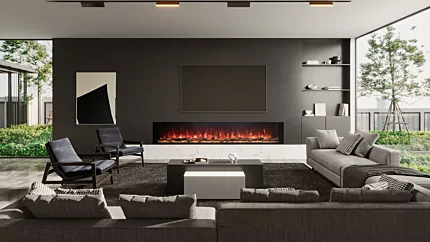
Switch 96SS Electric Fireplace
Every well-composed living space has a wall that the room organises itself around. When that wall holds a fire, the material covering it stops being a backdrop and becomes the architecture of the room's most-watched moment. That is why the best electric fireplace accent wall ideas start with material logic rather than mood boards: the wall and the flame are one composition, and the surface you choose decides how the fire reads from across the room. An electric fireplace places remarkably few constraints on that surface, which opens a materials conversation most fireplace owners have never been able to have. Stone, tile, timber and textured plaster each shape the feature wall differently, and each rewards a different kind of room.
Loading image...
Switch 96SS Electric Fireplace
You can finish the wall around an electric fireplace in almost any material you would use elsewhere in the home, including real timber, limewash, Venetian plaster and painted finishes, because the unit produces flame visuals through LED light rather than combustion. EcoSmart Fire has spent two decades shipping fireplaces into architectural projects across 75 countries, which is one reason its installation guidance for the Switch range states it plainly: install drywall, tile or the material of your choice right to the perimeter of the fireplace.
That sentence would be unthinkable for a wood or gas fire. Combustion appliances answer to chimney and venting standards such as NFPA 211, which Kristin Bigda at the National Fire Protection Association describes as covering chimneys, vents and solid-fuel appliances, and masonry fireplaces carry their own clearance rules under the International Residential Code. None of that framework applies to an electric firebox, because there is no flue, no combustion and no exhaust. The US Department of Energy makes the same distinction from the air-quality side: electric heaters produce no combustion by-products at the point of use.
For the wall itself, that translates into three freedoms:
No flue penetration, so the accent material runs uninterrupted from floor to ceiling
No combustion-driven clearance rules at the surround, so timber, plaster and paint can meet the firebox line
A zero-clearance firebox design across our electric fireplaces range, built to frame into standard stud walls
The design consequence is the interesting part. With wood and gas, the fire dictates the wall: materials retreat to prescribed distances and the surround becomes a negotiation. With electric fireplaces, the wall is designed first and the fire is integrated into it. Beyond keeping furnishings clear of the front of the unit during heating and leaving the air intakes unobstructed by cladding, the palette is genuinely open.
Loading image...
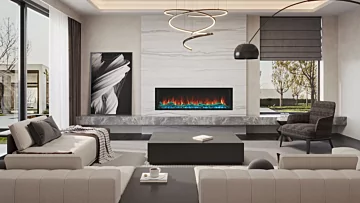
Switch 56SS Electric Fireplace
Stone gives a fireplace wall what no other material can: visual weight. A stone-clad wall reads as load-bearing even when it isn't, and that perceived permanence is exactly what a focal wall wants. Carney Logan Burke Architects used local sedimentary stone-clad fireplaces as the visual anchors of a Wyoming retreat featured in Dezeen, and the principle scales down to a single residential wall without losing force.
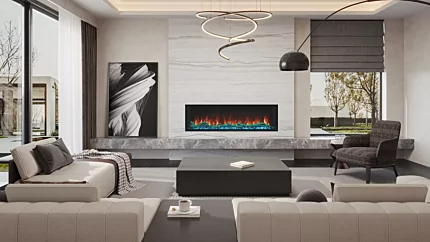
The first decision is tonal. Dark stone, honed basalt, charcoal limestone, deep slate, amplifies the flame: the fire becomes the brightest object on the wall and the eye goes nowhere else. Pale stone does the opposite, receding so the black fascia of the firebox reads as a deliberate graphic element, a dark horizontal line floating in a light field. Both are valid; each produces a different kind of room. A dark-on-dark scheme, where near-black stone dissolves into the black satin fascia our electric collections share, creates a monolithic wall where only the flame moves. High contrast keeps the composition crisp and architectural.
The second decision is surface. Honed and bookmatched slab faces suit minimalist interiors, and vein-matching across a wide wall turns the stone itself into the pattern, with the firebox sitting quietly inside it. Textured finishes such as split-face and stacked veneer catch the flame's light and throw small shadows, which adds life to the wall after dark. EcoSmart Fire's own framing guidance acknowledges granite, marble and veneer as common finishing choices, with one practical caveat worth carrying into any stone scheme: confirm the fireplace's actual dimensions before cutting custom stone, because natural materials don't forgive a re-cut. Weight and substrate are a builder's conversation, and worth having early, since heavy cladding changes how the wall behind the firebox is framed. It is the kind of specification detail a project manager handles at framing stage, not a constraint on the material choice itself.
Loading image...
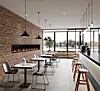
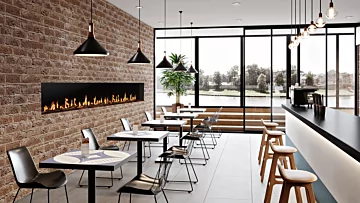
Motion 100SS Electric Fireplace
Tile is the most controllable of the four materials, which makes pattern discipline the whole game. Large-format porcelain has become the natural premium choice for a tile fireplace surround for one simple reason: fewer grout lines. Panels in stone-look and concrete-look faces read as a continuous surface, and the precise edges of large-format porcelain meet the clean line of a flush-mounted firebox without visual friction. The wall feels machined rather than assembled, which suits the frameless aesthetic of a recessed electric unit.
Handmade tile argues the opposite case. Zellige and other hand-glazed formats carry slight variation in every piece, and that irregularity is the point: the glazed surface catches flame light unevenly, so the wall shimmers rather than glows. Jane Englefield's Dezeen lookbook of statement fireplaces includes a fireplace clad in fluted Kaufmann tiles by Oslo studio Familien Kvistad, a reminder that tile can be sculptural, not just flat.
A short comparison helps the choice:
Large-format porcelain: monolithic, precise, quiet. Best in open-plan rooms where the wall is seen from a distance.
Zellige and handmade tile: tactile, light-responsive, intimate. Best in smaller rooms where the wall is read up close.
Two further decisions shape the result. Laying direction matters: vertical stack-bond draws the eye upward and flatters standard ceiling heights, while running bond widens the wall visually. And grout colour is a design decision, not an afterthought. Matched grout makes the tile read as one plane; contrasting grout turns the wall into a grid, which can be handsome but competes with the firebox. The discipline rule sits underneath all of it: the busier the tile, the more the zone immediately around the firebox should quieten down, so the flame remains the event.
Loading image...
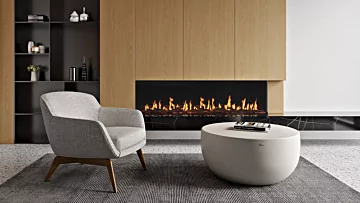
Motion 76RC Electric Fireplace
Fluted timber panels around an electric firebox are no longer a compromise; they are the defining premium accent wall treatment of the moment, and the pairing is fully available. Because the unit creates its flame with LED light rather than burning fuel, and because the firebox carries a zero-clearance design built for framing into standard timber or metal stud walls, real wood can sit against the surround in a way no combustion fire permits.
Valeria Montjoy, writing for ArchDaily, notes that ribbed and fluted panelling has consolidated its presence in contemporary residential interiors, answering a preference for sleek, tactile, structured surfaces. Around a fireplace the effect is specific: vertical battens create rhythm, the repeating shadow lines draw the eye upward, and a standard-height ceiling suddenly reads taller. Architect Cathy Purple Cherry used clear white oak to build a slatted wall around a fireplace in a project featured in Architectural Digest, which is about as direct an endorsement of the pairing as residential design offers.
Species tone sets the room's temperature. Pale oak leans Scandinavian: calm, bright, easy with linen and wool. Walnut leans moody: darker rooms, brass accents, evening light. Either way, the warm grain plays against the cool black fascia of the firebox, and that warm-against-black tension is what makes a fluted panel fireplace wall feel composed rather than decorated. The Switch fireplaces range, with six widths spanning 44 to 120 inches, gives a timber wall a long horizontal counterpoint to all that vertical rhythm. Shiplap deserves a brief mention as fluting's mass-market cousin; it still works in coastal and farmhouse rooms, but fluted panelling reads more current because the relief is finer and the rhythm tighter.
One quiet bonus: slatted timber panels do modest acoustic work, softening the echo of hard-floored living rooms. A fireplace wall that also tames the room's sound is doing double duty most accent materials can't.
Loading image...
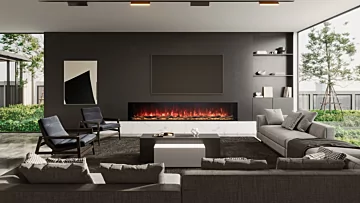
Switch 96SS Electric Fireplace
Texture is the quiet-luxury alternative to pattern, and it is the category that pairs most naturally with a frameless, flush-mounted electric firebox. A trowelled finish runs as one continuous surface with no trim, no grout and no joints, so the only interruption in the wall is the flame itself. Architectural Digest's AD PRO 2026 forecast traces the current appetite for texture back through the Venetian plaster and limewash wave, finishes that taught homeowners to want walls with depth rather than colour alone.
The three finish families suit three different rooms:
Venetian plaster: polished, faintly reflective depth. Flame light moves across the burnished surface, so the wall changes with the fire. Suits formal living rooms and rooms with evening use.
Limewash: matte, cloud-like tonal variation. Softer and more organic; suits relaxed, daylight-led spaces.
Microcement and tadelakt: seamless and mineral. The minimalist's option, ideal where the wall should read as a single cast surface.
Colour strategy does the rest. Warm neutrals and deep earth tones flatter every flame setting; near-blacks dissolve the fascia into the wall entirely, so the fire appears to hover in the surface. This is where flame quality earns its keep, because on a textured wall the light is half the show. The Motion fireplaces collection animates that surface with multi-dimensional flame patterns and a wood-crackle soundtrack, which gives a burnished plaster wall something to do all evening. Kara Mann's lobby for the Kimpton Claret Hotel in Denver, anchored by a hand-finished fireplace amid textural plaster and stone, shows how far the pairing carries in hospitality-grade interiors.
Loading image...
Switch 56SS Electric Fireplace
As a working principle, the fireplace should command the accent wall without filling it: wide enough that it reads as the wall's reason for being, narrow enough that the material around it keeps generous margins. A firebox that floats too small in a large wall looks like an afterthought; one that runs nearly edge to edge erases the accent material it was meant to showcase.
A few principles cover most rooms:
Match format to wall shape. Wide walls want linear, landscape fireboxes; the long horizontal line organises the wall the way a shelf or datum would.
Set the height to seated sightlines. The flame is watched from sofas, not standing, so the firebox centre belongs comfortably within the seated field of view.
Decide where the material stops. Full-height cladding makes the wall monumental; stopping the material at a datum line creates a calmer, more layered composition. Ceiling height decides which: the taller the room, the better full-height runs perform.
Choose symmetry deliberately. A centred firebox is restful; a deliberate offset is dynamic. Both are valid, but accidental near-symmetry reads as a mistake.
Protect the negative space. Empty wall around the firebox is not wasted; it is what signals restraint. The most expensive-looking feature walls usually have the least on them.
Every one of these principles assumes the unit can actually be sized to the wall, and that is where the specification stage earns its keep. With six widths in each of our electric collections, the Switch range spanning 44 to 120 inches and the Motion range from 30 to 120, the unit can be sized to the wall rather than the wall built around the unit, which is the proportion problem solved before the first material is ordered rather than patched afterwards. If a television enters the scheme, it changes the height and hierarchy logic of the whole wall and deserves its own careful planning rather than a footnote here.
The strongest electric fireplace feature wall schemes usually combine two materials, and the discipline that makes them work is dominance: one material leads, one supports, in roughly a 70/30 split. Equal halves fight; a clear hierarchy composes.
Three pairings that reliably work:
Stone hearth band below, plaster above: grounded weight at the base, soft tonal depth carrying to the ceiling. Suits generous living rooms.
Fluted timber flanking a tiled firebox column: rhythm on the wings, precision at the centre. Suits wide walls in open-plan spaces.
Microcement wall with a timber joinery shelf: seamless mineral field warmed by one horizontal wood line. Suits minimalist interiors.
Whatever the pairing, two rules hold. Match undertones across materials, warm with warm, cool with cool, because a pink-warm limestone against a grey-cool oak will always feel slightly off without the viewer knowing why. And keep the firebox zone visually quiet: junctions, pattern changes and material seams belong away from the flame, so the fire remains the wall's single event. A cautionary note on ambition: three or more materials on one wall almost always fragments it, turning a composition into a collage.
Across every scheme in this article, the constant is the firebox itself: a black, frameless horizontal line that behaves the same against stone, tile, timber or plaster. Choosing the electric fireplace feature wall material is really choosing what that constant line will sit inside.
The accent wall succeeds when the material and the fire are conceived as a single composition, and electric is the technology that makes the full palette available for that composition. The same absence of combustion that frees the wall from flues and clearance lines is what lets timber battens, limewash and bookmatched stone run to the firebox edge, and the same black, frameless fascia is what gives every one of those materials a consistent counterpoint to work against.
That is the real shift worth taking from these electric fireplace accent wall ideas: the question is no longer what the fire will permit, but what the room deserves. When the wall no longer has to negotiate with the fire, the material can finally do what good architecture has always asked of it, and the flame becomes the one moving element in a surface designed to hold it.