Loading image...

 © Comma Projects and Alyne Media
 You've seen the sleek fireplace without a chimney, the flame that seems to burn impossibly clean, and wondered how it works. Most people assume it's either too good to be true or too complicated to understand. Neither is accurate. Bioethanol burner technology is elegantly simple in principle, yet engineered with surprising precision to deliver the clean combustion and safety performance that define premium fireplaces. This article cuts through the marketing and shows you exactly how the engineering works - the combustion chemistry, the safety systems, and why design matters - so you can make an informed choice about whether bioethanol is right for your space.
Loading image...
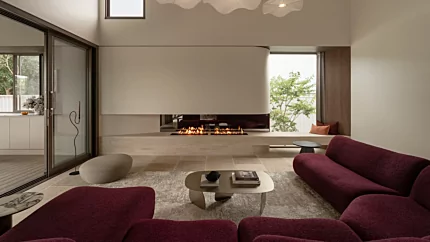
© Comma Projects and Alyne Media When you light a bioethanol burner, something remarkably clean happens. Bioethanol fuel vaporises from the burner's combustion chamber, mixes with oxygen from the surrounding air, and ignites. The result is a complete chemical reaction: bioethanol converts into carbon dioxide and water vapour, releasing heat energy in the process.
This cleanliness is why bioethanol fireplaces don't require a chimney. Traditional wood fires send smoke and particulates up the flue. Gas fireplaces need venting to handle combustion byproducts safely. Bioethanol, by contrast, produces only carbon dioxide and water vapour - the same substances you exhale with each breath. This is not marketing rhetoric; it's combustion science.
The energy density- approximately 26.8 MJ per litre of fuel - is what makes the flame sustainable and warm. This energy content is roughly equivalent to burning a candle, but concentrated in the burner's combustion chamber where it's released methodically over hours, not minutes. The chamber's design is everything. A well-engineered chamber ensures the fuel vaporises completely before igniting, distributes heat evenly, and maintains a stable flame. A poorly designed chamber leaves unburned fuel, produces odour, and wastes energy.
Think of the combustion chamber as a precision instrument: its shape, size, internal baffles, and heat-retention properties determine whether the burner delivers a clean, efficient flame or a sooty, inconsistent one. This is why all EcoSmart Fire models are engineered with specific chamber geometries rather than generic off-the-shelf inserts.
A flame arrestor is a safety device inside the burner that prevents flames from flashing back into the fuel tank. All certified bioethanol burners, including every EcoSmart Fire model, include a flame arrestor as a mandatory safety feature.
Here's the mechanical principle: the flame arrestor sits between the combustion chamber and the fuel supply, typically consisting of a metal mesh or baffle system. If fuel vapour pressure suddenly reverses - during refuelling or in a freak accident - the arrestor's mesh stops the flame from propagating backward into the tank. The mesh absorbs and disperses heat, quenching the flame before it travels. It's passive safety: no electronics, no batteries, just physics.
Why does this matter for indoor use? Building codes and safety standards require it. EcoSmart Fire's engineering, developed with UL 1370 certification, includes over 100 laboratory tests for flame behaviour and fuel spillage response. International standards - EN 16647:2015 for Europe and the UK, UL 1370 for North America, and Australia's ACCC mandatory standard (introduced July 2017) - all require flame arrestor technology in fuel containers. It's not optional; it's certification baseline.
Not all flame arrestors are engineered equally. Cheap burners often use thin, ineffective mesh that degrades over time. EcoSmart Fire's flame arrestor is specifically engineered for bioethanol's combustion profile, with materials and geometry chosen to withstand repeated heating cycles without degradation. This is a detail that separates certified, engineered products from commodity burners.
EcoSmart Fire offers two main burner geometries: round flames from the AB series for omni-directional heating, and elongated flames from the XL and XS series for linear installations. Round burners range from 2 kW to 6 kW; elongated models maintain 3–4 kW with greater visual spread.
The difference comes down to chamber shape and size. A round burner has a circular combustion area that radiates heat uniformly in all directions, like a traditional candle flame is magnified. This makes it ideal for island installations, centrepiece fireplaces, or spaces where you want guests to experience warmth from multiple angles. The AB3 heats approximately 15 m² of space; the AB8 covers up to 65 m².
Elongated burners, by contrast, have a linear combustion area - think of a long, narrow flame running the length of a built-in installation. This geometry concentrates heat along a single axis, perfect for mantels, wall-mounted fireplaces, or custom installations where you want the flame to follow an architectural line. The XL500 and XL900 maintain consistent 3–4 kW output while spreading heat across a wider visual footprint than round equivalents.
For architects and interior designers, this geometry distinction is critical. Round burners dictate a certain spatial logic - they pull the eye to a central point and require open space around them. Elongated burners integrate into walls, shelves, and built-in elements, becoming part of the architectural composition rather than the focal point. Choose the geometry that matches your installation vision, not the other way around.
The combustion chamber is where all the engineering precision pays off. Its job is simple: ensure fuel vaporises completely, mixes with air, burns cleanly, and produces consistent heat. How it achieves this separates premium burners from generic ones.
EcoSmart Fire uses three distinct combustion chamber approaches, each optimised for a different product range. The AB series uses steel wool stabilisation inside the chamber. The steel wool absorbs heat, distributes fuel vapour evenly, and stabilises the flame across the combustion surface. This design enhances flame stability and fuel efficiency, allowing the AB8 to achieve burn times of 5–6 hours at maximum flame intensity or 10–14 hours at a low, ambient setting.
The BK5, EcoSmart Fire's signature model, employs deep-draw fabrication - a seamless, precision-moulded chamber with no internal inserts. This design won the 2004 Australian International Design Award for its engineering elegance and performance. The seamless construction allows uniform heat distribution, minimal turbulence, and complete fuel vaporisation. There are no crevices where unburned fuel can accumulate; the result is odour-free combustion from the first ignition.
The XL and XS series use a purpose-designed baffle system inside the chamber. These baffles regulate the flame's spread, control fuel vapour distribution along the elongated combustion surface, and prevent hotspots that could cause uneven burn. The baffle approach allows precise tuning of heat output and flame aesthetics across a wider range of sizes.
Why does chamber design matter? Incomplete combustion - where fuel doesn't fully burn creates odour (often described as a faint alcohol smell), carbon deposits on the glass, and wasted energy. These aren't manufacturing defects in cheap burners; they're design failures. A chamber that's too small, poorly insulated, or without proper baffles can't achieve the residence time (the time fuel vapour spends in the combustion zone) needed for complete burn. This is why EcoSmart Fire's chambers are engineered to precise specifications, not stamped from generic templates.
Most bioethanol burners let you adjust flame height using a sliding lever or dial, which controls fuel flow to the combustion chamber. Turning the flame up increases fuel delivery, raising the flame height and heat output; lowering it reduces fuel flow, extending burn time and creating a softer ambience. This is not electronic magic - it's mechanical adjustment with predictable results.
The relationship between flame height and burn time is inverse and specific. EcoSmart Fire's AB8, for example, achieves 5–6 hours of burn time when set to maximum flame height (approximately 6 kW heat output), and 10–14 hours when adjusted to minimum flame (approximately 2–3 kW). The XL500 maintains similar proportions across a smaller total output range.
Why would you adjust the flame? Match the flame to your room size. A large, open-plan living room benefits from maximum flame height for visible warmth and rapid ambient heating. A bedroom or smaller study might use a lower flame setting for gentle ambience without excessive heat output. Some EcoSmart Fire models, like the XS340, are specifically designed for intimate spaces and feature a flip-lid fuel drawer that's simple to operate, even for first-time users.
A practical note: there is a minimum safe flame height below which the combustion process becomes unstable. This varies by model and is specified in the product manual. Setting the flame below this threshold can result in incomplete combustion. EcoSmart Fire's design margins ensure that even the lowest user-adjustable setting maintains safe, complete combustion.
Safety in bioethanol burners operates in layers. The first layer is the flame arrestor, which we've already covered. The second layer includes fuel tank design - all certified burners use robust, spill-resistant fuel containers with tight-fitting caps and safety markings. The third layer is a Top Tray requirement for indoor operation.
A Top Tray (also called a safety tray or catchment tray) is a shallow, heat-resistant container that sits directly beneath the burner. Its purpose is simple: if fuel spills during refuelling, the tray contains it rather than allowing it to spread across a shelf or floor. This isn't paranoia - it's standard practice in every building code that permits bioethanol fireplaces indoors. The tray must meet material specifications (typically non-combustible, thermally stable) and be sized to hold at least 120% of the burner's fuel capacity.
Certification is the third pillar of safety. Every EcoSmart Fire model undergoes rigorous third-party testing against international standards. In North America, UL 1370 certification involves over 100 laboratory tests covering flame behaviour, fuel spillage response, stability, heat output, and more. In Europe and the UK, EN 16647:2015 establishes equivalent safety requirements. In Australia, the ACCC mandatory standard (mandatory since July 2017) requires minimum device weight, footprint stability, and flame arrestor certification.
These certifications aren't marketing badges. They represent independent laboratory verification that the burner won't leak fuel, won't flashback when refuelled, won't tip over, won't produce dangerous levels of carbon monoxide, and will perform consistently for years. Professional specifiers (architects, hospitality designers, builders) rely on these certifications when proposing bioethanol fireplaces to clients or regulatory bodies. For homeowners, they mean insurance coverage and peace of mind.
Most EcoSmart Fire bioethanol fireplaces require a minimum room volume of 40–116 m³, depending on the model. No external venting is required; normal household air circulation is sufficient.
Why does room size matter? Bioethanol combustion produces CO₂ and water vapour - both harmless in the quantities generated, but they need space to dilute to safe concentrations. In a small, sealed room, CO₂ concentration could theoretically rise without adequate air exchange. Room volume calculations account for this. To calculate your room volume, multiply length × width × height in metres. A 4 m × 5 m × 2.6 m room is 52 m³ - suitable for burners up to the XL900 range.
The AB3 requires a minimum room volume of 40 m³; the AB8 requires 116 m³ due to its higher heat output. XL series models typically require 65–100 m³. Once you meet the minimum room volume, you don't need a dedicated extraction fan or external venting - natural air circulation (windows slightly ajar, normal door openings, household ventilation) is adequate. This is why bioethanol fireplaces offer such exceptional design flexibility compared to gas or wood alternatives.
A common misconception: “ventless” doesn't mean the room is sealed. It means no permanent flue connection is required. Natural air exchange - through slightly opened windows, doors, or household HVAC systems - provides the ventilation needed for healthy indoor air quality and optimal burner performance. In extremely sealed environments (fully insulated basements, converted wardrobes), you may need to crack a window slightly, but this is a design choice, not a technical requirement.
EcoSmart Fire has been refining bioethanol fireplace technology for over 20 years. That longevity alone matters, but the real differentiation lies in vertical integration: EcoSmart Fire owns e-NRG Bioethanol, the company that formulates the fuel. This is unique in the industry.
Most bioethanol burner manufacturers buy fuel from external suppliers and hope it burns well. EcoSmart Fire engineered both the burner and the fuel to work together. The combustion chamber geometry is optimised for e-NRG's fuel formulation; e-NRG's bioethanol is formulated for bioethanol burners. This synergy eliminates the variables that plague generic setups. Fuel quality directly impacts combustion cleanliness - poor bioethanol can leave deposits, produce odour, and waste energy. Premium bioethanol, formulated for the specific burner, delivers complete combustion and consistent performance.
This vertical integration is why EcoSmart Fire can stand behind citable performance claims. The AB8 doesn’t “approximately” burn for 5–6 hours; it burns for exactly that duration on e-NRG bioethanol at maximum flame setting. When architects specify EcoSmart Fire, they’re specifying both the burner and the fuel from a single source of responsibility.
The awards reinforce this heritage. The BK5 won the 2004 Australian International Design Award for engineering excellence. The XL series earned the 2009 Hearth & Home Vesta Award. These aren't marketing awards - they're industry recognition from bodies that scrutinise engineering, materials, and long-term reliability. For professional specifiers, this history signals confidence. For homeowners, it means you're buying a product that's been refined across thousands of installations and trusted enough to earn category-defining recognition.
Burner selection starts with your room volume and desired ambience. If your space is 50 m², you can safely use any burner from AB3 upward. If it's 120 m², you're limited to larger models like the AB8 or XL series. Once you've confirmed room compatibility, consider the installation type: round burners for islands and centrepieces; elongated burners for built-ins and mantels.
Installation prep is straightforward. All certified burners require a 600 mm clearance from combustible materials (walls, curtains, shelving). The burner sits on a non-combustible surface or in a built-in recess lined with approved materials. The Top Tray sits directly beneath the burner, containing any accidental spills. Initial curing is important: the first 2-hour burn may produce a faint alcohol odour as factory residues burn off. This is normal and usually diminishes after the second use.
Fuel filling is simple but requires discipline. Each burner has a dedicated filling point, clearly marked. You fill the tank with e-NRG bioethanol (or an equivalent premium-grade bioethanol from another source, though we recommend e-NRG for optimal performance), seal the tank, and allow the fuel to absorb into the burner's internal structure before igniting. Never overfill - fuel should not spill into the Top Tray during normal filling. Ignition and extinguishing procedures are covered in the product FAQ documentation.
Maintenance is minimal. After every 5–10 hours of burn time, wipe the inside of the glass with a soft, damp cloth to remove any light residue. Check the fuel tank for water contamination (bioethanol is hygroscopic and can absorb moisture if stored in humid conditions). If water has contaminated the fuel, the combustion will be imperfect and may produce odour. The maintenance and cleaning guide walks through recovery steps. Most issues - inconsistent flame, odour, weak ignition - trace back to fuel quality or user error in initial setup. Professional help should be sought if the burner won't ignite after fuel and electrical checks, or if flame behaviour is unstable.
The bioethanol burner market has consolidated into commodity territory. Search online and you'll find dozens of models that look similar, cost $200–500, and promise the same results. Most are generic burners manufactured to minimal standards, certified barely above the safety floor, and swapped between multiple brands. Performance varies wildly because no one is engineering the burner and fuel as a system.
Quality signals stand out. Certified burners (UL 1370, EN 16647, ACCC) have passed independent testing. Design awards indicate engineering depth beyond cost minimisation. Fuel brand ownership (e-NRG) shows vertical integration and long-term commitment. Chamber design that's proprietary - not generic - suggests engineering discipline. Burn time and heat output that's specific, not approximate, reflects confidence in testing and consistency.
Cheap burners use thin steel chambers, inconsistent mesh arrestors, and generic fuel suppliers. Over time, these burn inconsistently, develop odour, and degrade. Premium, engineered burners maintain a consistent flame, longer operational life, and predictable performance because every component is designed to work within precise tolerances. For architects and specifiers, this distinction is fundamental to client confidence. For homeowners, it means the fireplace you purchase in 2026 will perform as well in 2030 as it does today.
Bioethanol fireplace technology is not mysterious. It's precision engineering applied to combustion science - the same discipline that drives automotive engines and industrial heating systems. Understanding how the burner works, why safety systems matter, and how fuel quality affects performance doesn't just satisfy curiosity. It builds confidence that you're investing in a product engineered for long-term reliability, not a commodity that will disappoint a year from now.