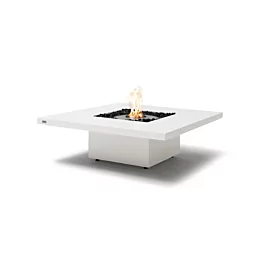
Loading image...


Most people think a bioethanol fireplace is simple. Pour in fuel, light it, enjoy the flame. And on the surface, that's true. But what separates a bioethanol fireplace that burns cleanly, consistently, and beautifully from one that doesn't comes down to decisions made long before the flame is ever lit. Decisions about materials, engineering, and standards that live inside the burner, the part of the fireplace most people never see.
At EcoSmart Fire, those decisions are everything.
Loading image...
The burner is the heart of any bioethanol fireplace. It determines how completely the ethanol combusts, how stable the flame is, and critically, what enters the air while it's burning. Every material inside the burner, every chamber, and every airflow pathway contributes to a cleaner burn or compromises it.
A poorly designed bioethanol burner, one built with ceramic wool or fibreglass fillers, inadequate airflow control, or no temperature regulation, can introduce contaminants into your indoor air. This is why EcoSmart Fire has spent two decades engineering burners that perform at a level the flame alone doesn't reveal.
Every EcoSmart Fire burner is built around a proprietary three-chamber architecture. At the centre is a single burning chamber, the only place where combustion occurs. Flanking it on either side are two adjacent fuel chambers, each packed with grade 304 stainless steel wool.
That stainless steel wool does two things simultaneously: it eliminates free air within those chambers to prevent uncontrolled combustion, and it regulates the temperature of the fuel before it reaches the flame. What arrives at the burning chamber is fuel at the right temperature, delivered at a controlled rate, with no competing airflow to disrupt the burn.
The result is complete, stable combustion: a cleaner bioethanol flame by design, not by accident.
There is no wick. No ceramic wool. No fibreglass. Nothing in the burner can off-gas contaminants or degrade over time in ways that affect your indoor air quality. Just grade 304 stainless steel throughout, a material chosen specifically because it performs at combustion temperatures without compromise.
Loading image...
Yes, when the right burner, fuel, and ventilation requirements are in place. EcoSmart Fire bioethanol burners are listed to UL 1370 (USA), EN 16647 Certified (EU/UK), and ACCC Safety Mandate compliant (Australia). These independent third-party certifications require our burners to meet specific performance thresholds for combustion quality, emissions, and safety. When used as directed, with e-NRG bioethanol fuel and in compliance with the room size and ventilation requirements in your product manual, your EcoSmart fireplace is certified, tested, and engineered for safe indoor use.
Significantly. Water content in bioethanol is one of the most important factors affecting combustion quality. Even small amounts of water lower flame temperature and lead to incomplete combustion, which is why fuel purity is not a minor detail. It is central to how cleanly your fireplace burns. e-NRG bioethanol is 99.8% alcohol, formulated specifically for clean burning in unvented decorative appliances. It is the only fuel approved for use in EcoSmart burners. The burner and the fuel are engineered together as a system, and one without the other is an incomplete equation.
Ventilation is a design requirement, not a suggestion. Our Operations Manual sets out minimum room volumes for every EcoSmart burner model, calculated by Underwriters Laboratories. When those volumes aren't met, adequate ventilation is required, such as keeping an internal door open or cracking a window at least 25.4 mm [1 in].
Every EcoSmart burner meets the UL minimum room volume requirement for its specific model. Follow the guidelines in your product manual, and your fireplace performs exactly as it was designed to: cleanly, beautifully, and with the indoor air quality your home deserves.
UL 1370 (USA), EN 16647 (EU/UK), and the ACCC Safety Mandate (Australia). What sets these apart from self-declared compliance is that they are independently verified against rigorous requirements for combustion quality, emissions, and safety. We also had a hand in developing UL 1370 with Underwriters Laboratories. We didn't just pass the test, we helped write it.
A bioethanol fireplace can affect indoor air quality if the burner is poorly designed, the fuel is of low purity, or ventilation requirements are not met. EcoSmart Fire addresses all three: our burners use a three-chamber stainless steel architecture with no ceramic or fibreglass fillers, our e-NRG bioethanol is 99.8% alcohol, and our Operations Manual specifies UL-calculated minimum room volumes and ventilation requirements for every model.
Bioethanol burners vary significantly in construction materials, internal design, and airflow control. Common burner designs use ceramic wool or fibreglass as fuel absorption material, both of which can off-gas contaminants under combustion conditions. EcoSmart Fire burners use grade 304 stainless steel wool, a single controlled burning chamber, and no wick, delivering more complete and stable combustion than open or wick-based designs.
Formaldehyde is a naturally occurring compound found in many everyday foods, including apples, bananas, tomatoes, and spinach, and is off-gassed by household furniture, flooring, and electronics. It is part of normal indoor environments at low levels.
EcoSmart Fire burners are listed to UL 1370 and EN 16647, both of which include emissions performance requirements. A properly installed EcoSmart Fire, using e-NRG bioethanol and operated in accordance with the room size and ventilation guidelines in your product manual, is tested and certified to perform within those requirements.
Only e-NRG bioethanol should be used in EcoSmart Fire burners. e-NRG is 99.8% alcohol, formulated specifically for unvented decorative appliances. Using any other fuel affects combustion quality and voids the product warranty.
Ventilation requirements depend on your specific EcoSmart burner model. In a home of typical construction, natural air infiltration is generally sufficient. However, if the room is smaller than the minimum volume specified for your burner model, you should keep an internal door open or crack a window at least 25.4 mm [1 in]. Minimum room volumes for every EcoSmart burner are listed in your product manual and on our website.


















































































-outdoor-elegance-5531-screen.png)
-outdoor-elegance-5531-screen.webp)